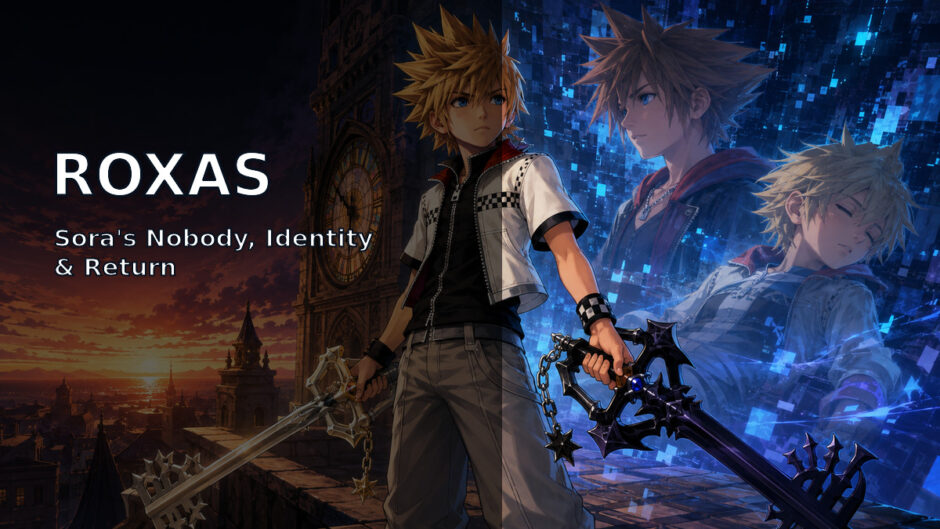

Roxas is Sora’s Nobody, but he does not remain an empty copy of Sora. He is born when Sora becomes a Heartless in KH1, develops his own identity through Axel and Xion, returns to Sora so the original hero can wake, and eventually receives a replica body that allows him to live as a separate person.
This guide explains how Roxas is created, why he looks like Ventus instead of Sora, how he can use two Keyblades, what happens to him in 358/2 Days and KH2, and how he returns in Kingdom Hearts 3.
This article covers KH1, Chain of Memories, 358/2 Days, KH2, Dream Drop Distance, and KH3.

If Roxas is Sora’s Nobody, why does he have Ventus’s face—and why does he deserve his own body?
His appearance comes from Ventus’s heart, but his personhood comes from lived experience. Roxas becomes himself by forming memories and bonds no one else can replace.
目次
- Who is Roxas? The direct answer
- How Roxas is born during Kingdom Hearts 1
- Why Roxas has no memories of Sora
- Roxas’s story in 358/2 Days
- Why Riku captures Roxas
- Roxas’s story in Kingdom Hearts 2
- Why Roxas looks like Ventus
- How Roxas returns in Kingdom Hearts 3
- How Roxas can wield two Keyblades
- Japanese Reading Note: the name Roxas and “I am me”
- Roxas’s most important relationships
- Why Roxas matters to Kingdom Hearts
- Official sources and related reading
Who is Roxas? The direct answer
Roxas is the Nobody created from Sora’s body and soul when Sora releases his heart at Hollow Bastion. He becomes Organization XIII’s Number XIII and uses the Keyblade to defeat Heartless, unknowingly releasing hearts for Xemnas’s artificial Kingdom Hearts.
Unlike a normal Nobody, Roxas is born without Sora’s conscious memories. Sora quickly regains human form through Kairi’s light instead of remaining a Heartless, while Ventus’s sleeping heart is also connected to Sora’s body. These unusual conditions allow Roxas to develop separately.
| Question | Answer |
|---|---|
| Is Roxas Sora? | He originates from Sora’s body and soul, but develops his own heart, memories, choices, and relationships. |
| Why does Roxas look like Ventus? | Ventus’s heart was inside Sora when Roxas was born and influenced the Nobody’s appearance. |
| Why can Roxas dual-wield? | He has access to Sora’s Keyblade connection and Ventus’s heart/Keyblade connection; Xion’s loss awakens the second weapon in practice. |
| Does Roxas die in KH2? | He rejoins Sora and loses independent physical existence, but his heart remains within Sora and later enters a replica body in KH3. |
How Roxas is born during Kingdom Hearts 1

Sora uses the Keyblade of heart on himself to free Kairi. His heart becomes a Heartless, while his body and soul produce Roxas. At the same time, Kairi’s heart leaves Sora’s body and produces the special Nobody Naminé through the same body-and-soul event.
Sora is restored almost immediately when Kairi recognizes him. Roxas therefore coexists with a human Sora, a situation that breaks the ordinary rule in which a Nobody exists while its original person remains incomplete.
Why Roxas has no memories of Sora
Most Nobodies retain memories of their human life. Roxas does not. The games connect this exception to Sora’s unusually short time as a Heartless and to the complicated presence of Ventus’s sleeping heart.
Without inherited memories to dictate his personality, Roxas begins almost blank. Organization XIII gives him a name, coat, number, and job. Axel and Xion give him shared time. The difference is crucial: the Organization assigns an identity from above, while friendship allows an identity to grow from within.
Roxas’s story in 358/2 Days
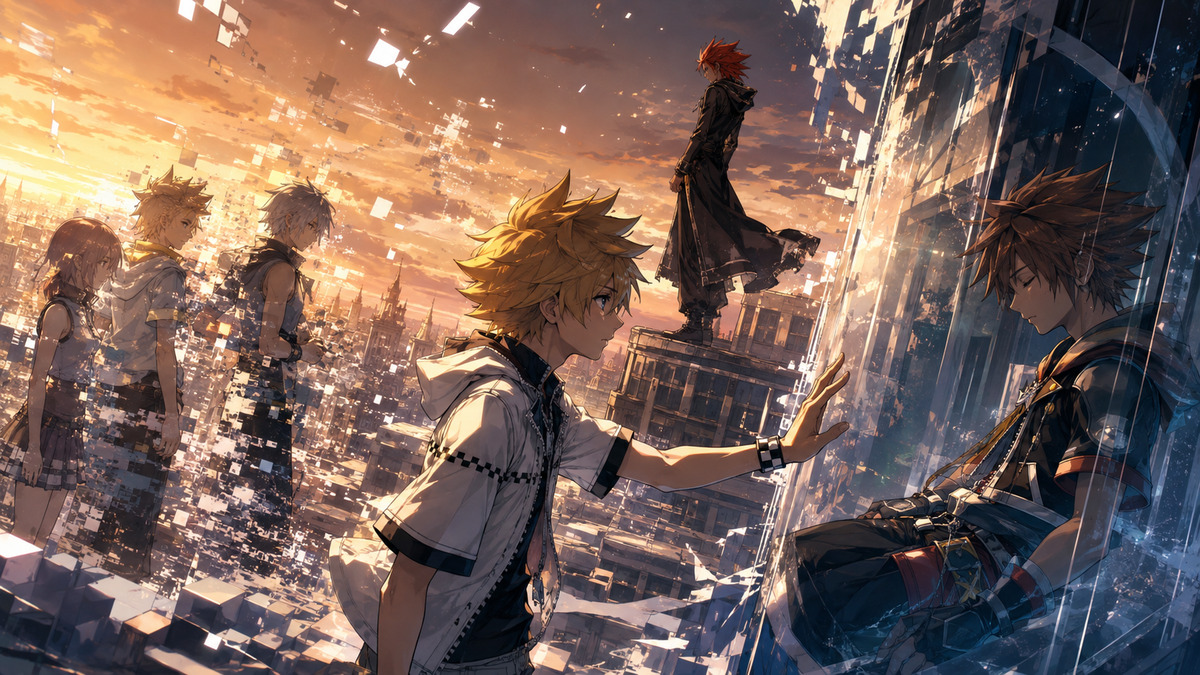
He joins Organization XIII as Number XIII
Xemnas finds the newly born Roxas and adds the letter X to an anagram of Sora, creating “Roxas.” The Organization sends him to defeat Heartless because a Keyblade releases the hearts trapped inside them.
Axel and Xion teach him what friendship feels like
Roxas eats sea-salt ice cream with Axel on Twilight Town’s clock tower. Xion, introduced as Number XIV, joins them. These ordinary meetings are not filler: they give three beings treated as tools a routine they choose for themselves.
Xion absorbs Sora’s memories and Roxas weakens
Xion is a replica built to copy the Keyblade’s power through Sora’s memories. As Naminé attempts to restore Sora, those memories flow between Sora, Roxas, and Xion. Xion grows stronger and more Sora-like while Roxas loses strength. Both are told that only one can remain.
Why Roxas fights and defeats Xion
Xemnas alters Xion so she will absorb Roxas. Xion instead chooses to let Roxas defeat her, returning the memories she carries to him and preventing Xemnas from using her as intended. As she disappears, almost everyone forgets her because her existence was built from memories that return to their source.
Roxas’s grief awakens his dual Keyblades. He leaves the Organization and plans to free Kingdom Hearts, but he no longer clearly remembers the person whose loss motivated him.
Why Riku captures Roxas
Roxas tries to reach The World That Never Was. Riku blocks him because Sora cannot wake until his missing memories return. Roxas initially defeats Riku, forcing Riku to release Ansem’s dark power. Riku wins in Ansem’s form and takes Roxas to DiZ.
Riku’s mission is necessary for Sora, but it is not morally clean for Roxas. He is captured and placed in a false world without informed consent. Kingdom Hearts later takes Roxas’s anger seriously rather than pretending that Sora’s need automatically erases Roxas’s rights.
Roxas’s story in Kingdom Hearts 2
The seven-day summer vacation is simulated
DiZ places Roxas in a digital Twilight Town and supplies false memories of Hayner, Pence, and Olette. Strange glitches appear as Sora’s memories approach completion. Naminé tells Roxas that he is connected to Sora, while Axel tries to retrieve him.
Why Roxas returns to Sora
Roxas reaches the hidden mansion and sees Sora sleeping in the restoration pod. He understands that the simulated life is ending and rejoins Sora. This allows Sora to wake, but Roxas experiences it as the theft of a life that had only just become his.
Roxas fights Sora inside his heart
Later, Roxas confronts Sora at the Station of Awakening. The duel gives his suppressed will direct form. Sora wins, yet afterward begins to recognize Roxas as a person rather than a component. Roxas and Naminé also speak through Sora and Kairi near the ending.
Read the entire sequence in our KH2 story and ending explained.
Why Roxas looks like Ventus
At the end of Birth by Sleep, Ventus’s damaged heart takes shelter inside young Sora. Years later, Sora’s body and soul become Roxas while Ventus’s heart is still resting there. Ventus’s presence shapes Roxas’s face and voice.
Roxas is therefore not Ventus reincarnated, not Ventus’s Nobody, and not a time-traveling Ventus. Ventus explains Roxas’s appearance and second Keyblade connection; he does not explain away Roxas’s identity.
How Roxas returns in Kingdom Hearts 3
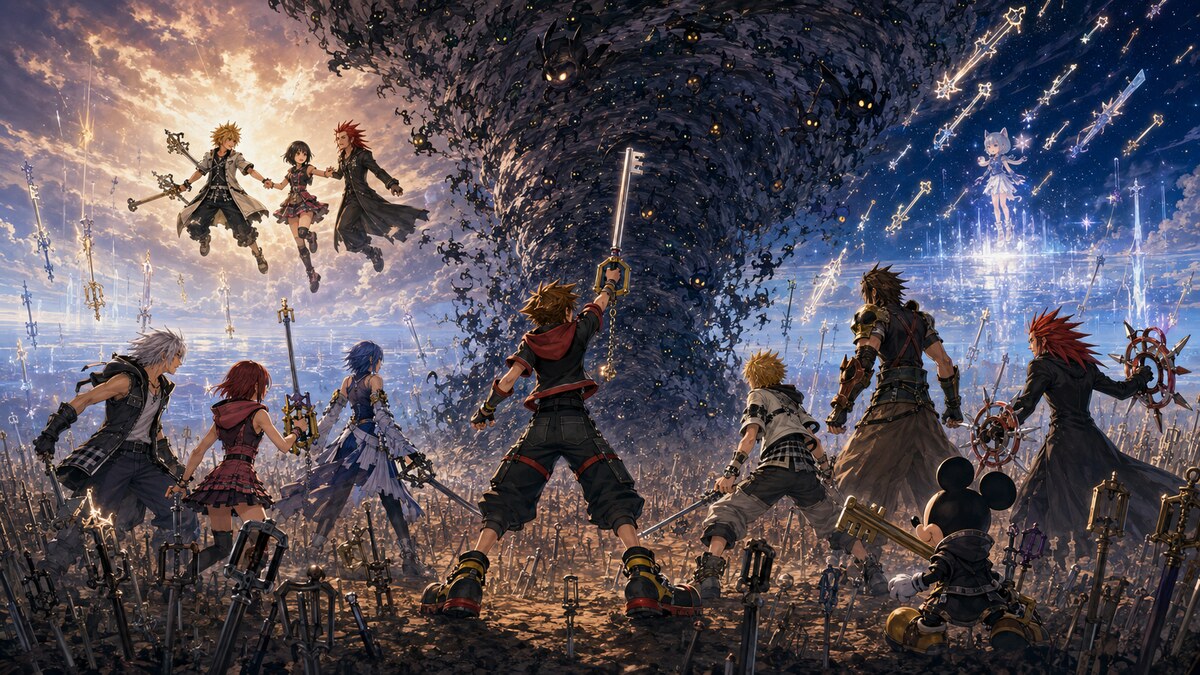
Sora discovers three hearts inside him
Ienzo’s analysis confirms that Sora contains three additional hearts: Roxas, Ventus, and Xion. The discovery reframes earlier language about Nobodies. Roxas did not merely leave data behind; he grew a heart that continued to exist within Sora.
A replica body solves the physical problem
Vexen secretly supports the restoration effort and supplies replica technology. A prepared replica can hold Roxas’s heart and recreate his appearance. During the Keyblade Graveyard battle, Roxas’s heart transfers from Sora into that vessel.
Roxas reunites with Axel and Xion
Roxas immediately protects Lea and Xion. After the battle, the three return to the clock tower and share sea-salt ice cream, now joined by friends from both sides of Roxas’s life. The ordinary scene is the reward: he no longer needs a mission or borrowed identity to justify existing.
See our KH3 + Re Mind ending guide for the full restoration sequence.
How Roxas can wield two Keyblades
Roxas’s first Keyblade access comes from being Sora’s Nobody. The second is connected to Ventus’s heart residing within Sora’s body and soul when Roxas is born. Xion’s defeat and returned memories trigger the visible awakening of dual-wielding.
Oathkeeper and Oblivion visually connect Roxas to Kairi and Riku through Sora’s memories. They also express his conflict: one weapon associated with promises and one associated with loss.
Japanese Reading Note: the name Roxas and “I am me”
Roxas is “Sora” rearranged with the Organization’s X added. Xemnas names recruits by transforming the names of their former selves, symbolically claiming authority over the identity that remains.
Roxas repeatedly insists on a simple Japanese idea: ore wa ore da (俺は俺だ), “I am me.” He uses the same casual masculine pronoun ore as Sora, but the sentence is not proof that they are identical. It is a refusal to be reduced to Sora, Ventus, a Nobody category, or an Organization number.
Roxas’s most important relationships
- Sora: his original person and later the shelter for his independent heart. Read Sora’s full story.
- Axel/Lea: mentor, friend, and the person who cannot choose cleanly between Roxas and the Organization.
- Xion: fellow created being whose loss awakens Roxas’s rebellion and dual wielding.
- Ventus: the sleeping heart that influences Roxas’s appearance and weapon access.
- Riku: the person who defeats and captures Roxas so Sora can wake. Read Riku’s redemption explained.
Why Roxas matters to Kingdom Hearts
Roxas tests the series’ claim that hearts grow through connection. If a heart can form in a Nobody, then origin is not destiny. A body created as Sora’s leftover can become a person through a year of choices.
Roxas’s happy ending is not becoming Sora; it is reaching a world where Sora and Roxas can both exist. KH3’s replica solution matters because it rejects the sacrifice the earlier story treated as unavoidable.
Official sources and related reading
- Square Enix Japanese timeline: 358/2 Days
- Square Enix Japanese timeline: KH2
- Square Enix Japanese timeline: KH3 + Re Mind
Roxas begins with Sora’s body, Ventus’s face, and Xemnas’s name—yet none of those things gets the final word.
Exactly. His story turns identity from something assigned at birth into something built through memory, grief, friendship, and choice.